
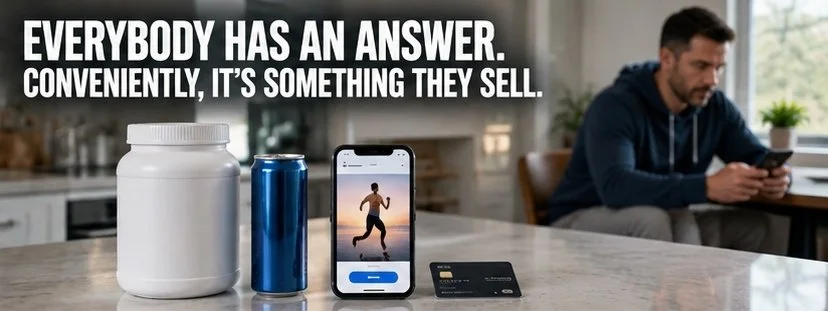
You want to lose fat, build some muscle, have more energy, and feel better about yourself.
So you start looking for answers.
Now your feed is full of powders, drinks, peptides, fat-loss injections, body-sculpting treatments, and programs that promise to fix whatever you’re unhappy with.
Everybody has an answer. Conveniently, it’s usually something they sell.
I’m a coach, and I own a supplement company (Apogee Performance Nutrition). I sell products and services too. So I’m not going to sit here and pretend that selling something automatically makes someone dishonest.
But you need to recognize when someone is educating you and when they’re working you toward a purchase. Sometimes they’re doing both.
Their job is to make the offer appealing. Your job is to decide whether the damn thing deserves your money, let alone a place in your body.
Your frustration is part of the sales pitch
Think about what gets your attention.
The stomach you can’t seem to lose. The energy you used to have. The muscle you’re struggling to build. The feeling that you’re getting older and losing control of your body.
Those are personal concerns. They matter to you.
They’re also useful selling points.
Someone tells you they understand exactly what you’re going through. Then they explain that your real problem is something you probably haven’t heard of, followed by the product or treatment that supposedly fixes it.
Maybe there’s something to it. Most likely they’re taking a real piece of physiology and stretching it well past what the research supports.
Either way, “That sounds like me” is not enough reason to buy.
You should feel understood by someone helping you. You should not feel diagnosed by an advertisement.
Looking good doesn’t make someone qualified
I don’t care how lean someone is, how many followers they have, or how confidently they talk into a camera.
Ask them to support what they’re saying.
A testimonial does not establish that a product works. Even an honest endorsement needs more behind it when it’s being used to make a health claim. The Federal Trade Commission (FTC) requires appropriate scientific support, not just happy customers and convincing delivery.
Somebody can sincerely believe a product helped them and still be wrong about what caused the improvement.
And when someone sells the training, the diet, the supplements, and the recovery treatment together, which part produced the result?
That’s a question worth asking before you buy the whole package.
Powders and drinks: some are useful. That doesn’t make every claim true.
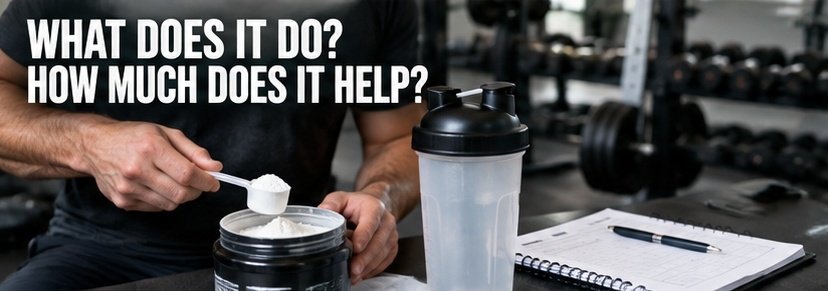
I use supplements. I sell supplements. There are products that can serve a legitimate purpose.
Protein powder is a convenient way to help meet protein needs. Creatine has good support for improving high-intensity exercise performance and helping with training adaptations. Neither one needs to be sold as a miracle to be useful.[nih]
Pre-workouts can be useful too. Caffeine has an ergogenic effect, meaning it can improve exercise performance. It can reduce perceived effort and help performance in certain exercise settings, with particularly consistent support for endurance activity. That’s a real benefit, not just marketing.[nih]
My pre-workout (Outer Limit) contains caffeine, beta-alanine, betaine anhydrous, L-citrulline, N-acetyl L-tyrosine, and taurine.
But owning the product doesn’t give me permission to act like every ingredient has the same level of research behind it, or that an ingredient list by itself proves how well a finished formula works. The doses, forms, and combination matter. Research on individual ingredients is not automatically research on the product sitting in your hand.
Beta-alanine is a good example of why details matter. It can support certain high-intensity efforts when taken consistently over time. The tingling you might feel after a serving is a side effect, not proof that you’re getting a better workout. Research on ingredients such as betaine and citrulline is more mixed than the research on caffeine.
And more caffeine is not automatically better. It can cause sleep problems, anxiety or restlessness, and a racing heartbeat. Your total intake matters, including the coffee and energy drinks you had before your pre-workout.
That’s how this conversation should work. Explain the benefit, explain the limits, and stop pretending a scoop of powder is going to change someone’s life.
Weight-loss supplements deserve even more skepticism. NIH notes that evidence for many of these products is weak, and some can be harmful.
Before buying, ask yourself what you expect it to do.
Help you meet a protein target? Improve performance during training? Those are specific jobs.
“Fix my metabolism” is a much bigger claim. Make them prove it.
Peptides: slow the hell down before you inject something
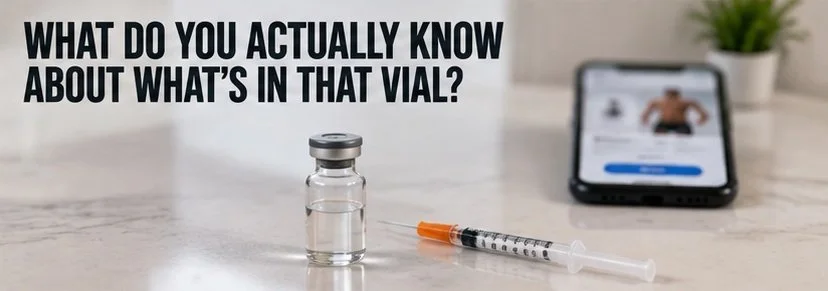
This is where I want people asking harder questions.
The word “peptide” gets thrown around like it means advanced, effective, and safe. It doesn’t tell you enough to make that decision.
Some peptide-based drugs are established medical treatments. That does not validate every substance being sold under the same broad label. FDA-approved GLP-1 medications and unapproved products marketed online are not interchangeable.
You need to know exactly what the substance is, what human research supports its use, where it came from, and what is known about the risks.
Take BPC-157. The FDA has flagged potential immune reactions, peptide-related impurities, and insufficient safety information to know whether proposed uses could harm humans.[fda]
Read that again before accepting “everybody’s using it” as reassurance.
Not knowing whether something causes harm is not the same as knowing it’s safe.
And “research use only” should not make you feel like you’ve found an insider deal. You should be asking why you’re considering putting something in your body that isn’t being sold as an approved medicine for human use.
Before using an injectable product, get clear answers:
• What exactly am I taking?
• Is it approved for the use being recommended?
• What controlled human research supports that use?
• Who manufactured and dispensed it?
• How are the identity, strength, and sterility verified?
• Who is evaluating whether I should take it?
• Who handles a complication?
If the person selling it can explain how to pay faster than they can explain the risks, leave it alone.
You don’t owe anyone a chance to experiment on you.
Drugs can work. That doesn’t make casual use a good idea.
The argument against reckless drug use should not be “none of it works.”
Some drugs work very well. That’s part of why you need to take them seriously.
Prescription weight-management medications can help appropriate patients. They are legitimate treatments, and using one under qualified medical care is not a moral failure. They also don’t replace healthy eating and physical activity.
But a legitimate medication can still be marketed irresponsibly.
Don’t confuse an easy buying process with a thorough medical evaluation. Before accepting a prescription, you should understand why it’s appropriate for you, what the risks are, how you’ll be monitored, and what the longer-term plan involves.
Be especially careful with unapproved versions sold as though they’re equivalent to an approved drug. The FDA has received reports of dosing errors involving compounded injectable semaglutide, including cases requiring hospitalization. It has also received reports of adverse events involving compounded semaglutide or tirzepatide prescribed at doses beyond approved labeling.
Compounding can serve legitimate medical needs, but compounded drugs are not FDA-approved and do not undergo the same premarket review for safety, effectiveness, and quality.
Ask what you’re actually receiving. Don’t settle for “it’s basically the same thing.”
And don’t let an influencer’s willingness to use drugs become your risk assessment.
They don’t have to live with your consequences.
Medspa fat-loss promises need a much closer look

A nice office, good branding, and someone wearing scrubs can make a sales pitch feel like medical advice.
Still ask the questions.
What is this procedure actually expected to do? Reduce a small localized fat bulge? Temporarily change the circumference of an area? Improve the appearance of cellulite?
Those are different outcomes. None should be casually presented as the same thing as losing weight and improving your health.
The FDA specifically states that non-invasive body contouring does not treat obesity, improve health, or produce the health benefits associated with weight loss. Some devices can reduce small amounts of fat in a treated area, but results vary and may be temporary.
That distinction needs to be part of the consultation, not buried under the financing options.
And “non-invasive” does not mean harmless.
Depending on the procedure, complications can include pain, burns, scarring, nerve damage, and changes in skin color. Some complications can be permanent or require surgery.
Fat freezing has a complication called paradoxical adipose hyperplasia, where the treated fatty tissue grows instead of shrinking. It does not go away on its own and may require surgery to correct.
That doesn’t mean everyone will have a bad outcome. It means “no surgery” is not a complete explanation of risk.
Before you agree to anything, ask:
• What exact device and procedure are you using?
• Is that device authorized for this specific use and body area?
• What result should someone like me realistically expect?
• What percentage of your patients get that result?
• Could the result be temporary?
• What will the full course of treatment cost?
• What can go wrong, and who treats it?
• What happens financially if I need corrective care?
Then take the answers home and think about them.
You do not need to make a medical or cosmetic decision because a package price expires Friday.
Programs should help you stop guessing
A coaching program can be worth paying for. Structure, feedback, accountability, and a plan that fits your life can be valuable.
But a program should do more than keep you excited about the person selling it.
The National Institute of Diabetes, Digestive, and Kidney Diseases (NIDDK) recommends looking for weight-management programs that include a sustainable eating plan, appropriate physical activity, and ongoing support for building habits.
Ask what you’ll actually learn.
Will you understand how to train? How to manage your food? How to adjust when progress slows? How to handle a busy week without deciding the whole plan is ruined?
Or will you just get another set of rules you follow until you get tired of them?
I sell coaching. I should be able to explain what you’re paying for without acting like I’ve discovered something nobody else knows.
The same standard applies to every coach you consider.
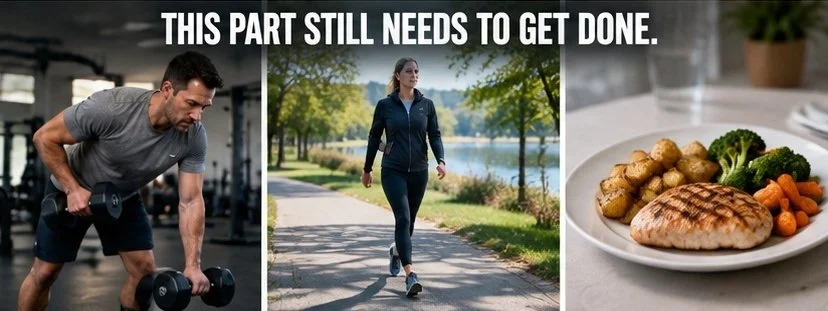
The fundamentals still need to get done
I’m not telling you to reject every supplement, medication, or procedure.
I’m telling you to stop giving them credit for things they cannot replace.
Resistance training and cardio
You need both in a sensible plan.
General adult guidelines recommend at least 150 minutes of moderate-intensity aerobic activity per week, or an equivalent amount of vigorous activity, plus muscle-strengthening activity on at least two days. You can build toward that from your current ability.
You don’t need to destroy yourself in the gym. You need something appropriate that you’ll keep doing.
Food that supports the goal
For fat loss, you need an eating pattern that helps you consume fewer calories while meeting your nutritional needs. It also needs to be something you can maintain.
In practical terms, build more meals around protein, vegetables, fruit, beans, and other filling foods. Give yourself enough actual food to feel like you ate a meal.
Choosing nutrient-dense foods that give you more food volume for fewer calories can make that easier. That doesn’t mean calorie-dense foods are automatically bad. It means portions still matter.
You don’t need to be afraid of food. You need to understand how your usual eating habits line up with what you’re trying to accomplish.
A routine you can repeat
This is the part nobody can put in a tub.
When will you train? What will you eat when you get home late? What keeps happening on weekends? What do you need to change so you’re not starting over every Monday?
A worthwhile plan helps you work through those problems. Ongoing support and habit-building are part of what NIDDK recommends looking for, not optional extras after the “real” program.
You can pay for help with this. There’s nothing wrong with that.
But paying for help and doing the work are still two separate things.
Before you buy, make them answer this
You don’t have to become an expert in everything. Start with a few questions.
1. What exactly is this supposed to do?
2. What evidence supports that specific claim?
3. Does that evidence apply to this product, dose, procedure, and person?
4. How much improvement is realistic, not just possible?
5. What are the risks, and what is still unknown?
6. Who gets paid if I say yes?
7. Is there a simpler, safer, or less expensive way to address the problem?
These are reasonable questions. Scientific support should match the claim being made, and testimonials don’t replace it.
Anyone asking you to spend money on your health should be willing to have that conversation.
Wanting results doesn’t mean you have to buy the promise
I understand wanting something to make this easier. Most people aren’t looking for a shortcut because they’re lazy. They’re frustrated, overwhelmed, or tired of putting effort into the wrong things.
That’s exactly when you need to slow down.
Some products are useful. Some treatments are appropriate. Some programs are worth every dollar.
But you should not have to ignore weak evidence, unanswered questions, or meaningful risks to believe in them.
Ask more of the people selling to you. Including me.
And before you buy another solution, take an honest look at what’s already happening with your training, food, and daily routine.
You may need better help with those things. You may need medical care too.
What you don’t need is another person turning your frustration into a recurring payment without making your life any better.
Ryan Padilla
Apogee Fitness Training
