
Every January, people decide this is the year they’ll get in shape.
They want to build muscle, lose some fat, have more energy, and feel better in their own skin. Those are worthwhile goals. If that’s where your head is right now, I want you to give yourself a real chance to follow through.
For some people, that means joining a gym. For others, it means making room to train at home.
If I were building a home gym this Christmas, I’d focus on equipment that supports years of progress, not just a few weeks of New Year’s motivation. A handful of useful pieces, enough weight to get stronger, and a setup that fits the space I actually have.
The equipment below comes to approximately $1,578 before tax, shipping, and Versa Gripps. That’s a meaningful investment. But compare it with a $50 monthly gym membership. You’re paying $600 a year, which puts this setup at less than three years of membership payments. After that, you still own the equipment. That only becomes a membership savings if you cancel or avoid a membership, of course, but there’s another benefit: removing the commute. No extra drive, no traffic between you and your workout, and one less thing to arrange on a busy day. You still have to train, but getting started can be as simple as walking into the next room.
My philosophy is buy once, cry once.
That doesn’t mean buying the most expensive equipment available. It means buying with the long term in mind, so you’re not replacing things as soon as you start making progress.
And you don’t have to buy everything at once. If your budget only allows for the dumbbells and bench this Christmas, start there. You can put them to work immediately and build the rest over time.
Here’s how I’d do it.
Disclosure: This article contains affiliate links. I may earn a commission if you purchase through these links. As an Amazon Associate, I earn from qualifying purchases. Prices listed are approximate and may change.
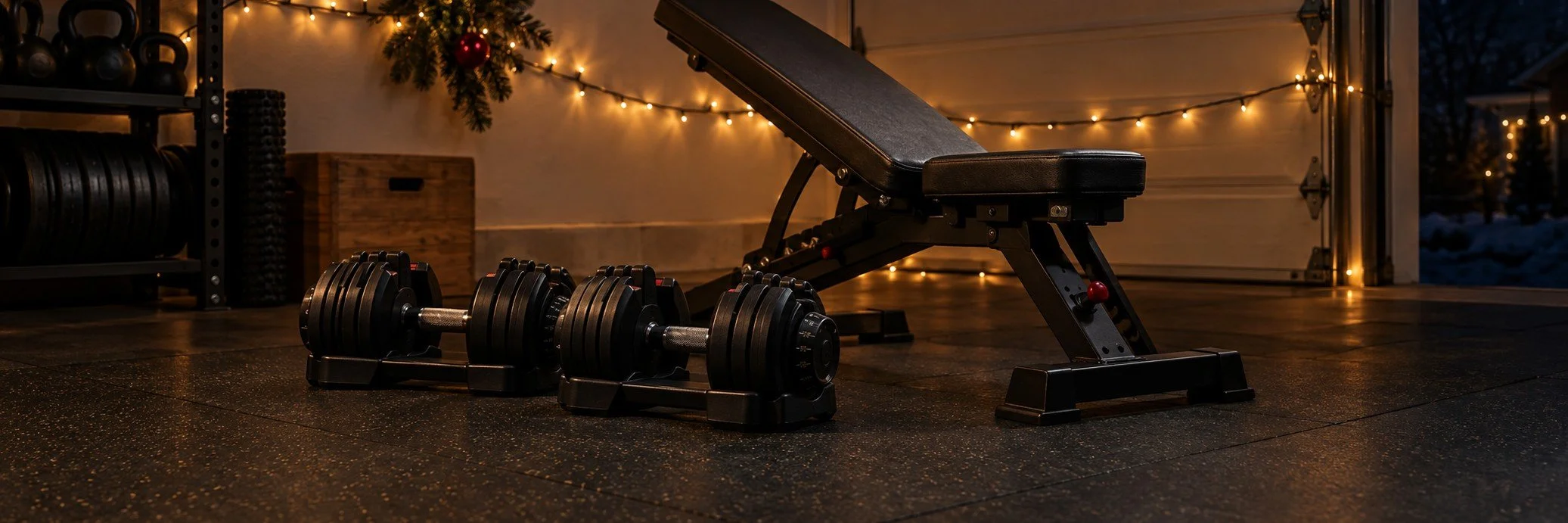
1. QIPAKA Adjustable Dumbbells: Start Here and Get to Work
Approximate price: $449.99 per pair
If I were starting from nothing, these would be my first purchase.
These are the adjustable dumbbells I use in my own home gym and my mobile training business. They adjust from 5 to 85 pounds per dumbbell in 5-pound increments, and the price includes the pair.
That’s a useful range without having to buy and store an entire rack of individual dumbbells.
You can use them for presses, rows, squats, Romanian deadlifts, lunges, curls, triceps work, and more. With a good program, you have plenty of ways to challenge your whole body.
What I like about this range is that it gives you somewhere to go. You’ll need lighter weights for some exercises and heavier weights for others. As you get stronger, you want equipment that lets you keep moving forward.
That’s the mindset I want you to bring into the new year. Don’t just buy something for the person you are today. Give yourself room to become stronger.
Shop the QIPAKA adjustable dumbbells
2. GOIMU Adjustable Bench: Build Out Your Starting Setup
Approximate price: $199.99
My next purchase would be an adjustable bench.
If I’m buying one bench for a home gym, I want options. This GOIMU bench has nine backrest positions, ranging from a 15-degree decline to an 85-degree incline, plus two leg-pad adjustments.
That gives you flat, incline, and decline positions for pressing, along with support for exercises such as chest-supported rows and seated shoulder presses.
The manufacturer lists a 1,300-pound capacity. When looking at bench capacities, remember that the load includes your body weight and the weight you’re lifting.
One practical detail: this bench does not fold. Make sure you have a place for it before ordering.
Together, the bench and adjustable dumbbells cost approximately $649.98.
If that’s your starting budget, you don’t need to apologize for starting there. Buy them, learn your exercises, follow your program, and build some consistency. You can accomplish a lot while you’re saving for the rest of the gym.
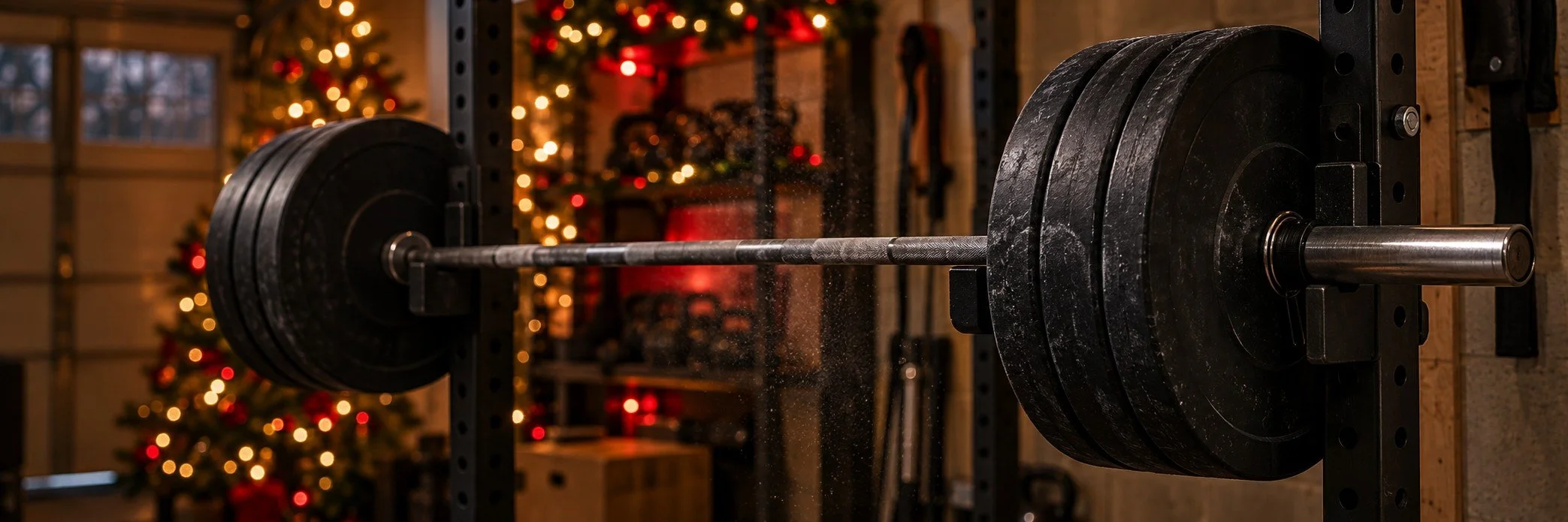
3. MIKOLO Folding Wall Rack: Add Barbell Training Without Taking Over the Garage
Approximate price: $299
Once the dumbbells and bench were covered, I’d start building out the barbell side of the gym.
This MIKOLO rack mounts to the wall and folds away when you’re finished. That makes it worth considering if your training space also needs to function as a garage.
The listed dimensions are:
• Open: 47 inches wide, 19.7 inches deep, and 85.8 inches tall.
• Folded: 47 inches wide, 2 inches deep, and 85.8 inches tall.
• Pull-up bar: approximately 89 inches off the ground.
It uses 2-by-2-inch, 13-gauge steel uprights and has a manufacturer-listed capacity of 1,000 pounds. The package includes a quick-attach pull-up bar, J-cups with protective plastic inserts, and a landmine attachment.
That gives you a place for barbell squats and presses, plus options for pull-ups and landmine exercises, without buying separate stations for everything.
Before ordering, measure your space carefully. Account for the full barbell, room to load plates on both sides, and clearance above the pull-up bar. You need space to train, not just enough wall space to mount the rack.
Follow the mounting instructions and confirm that your wall construction is appropriate. Also check which compatible safety arms or other safety provisions you’ll need. Don’t assume the package includes every accessory required for the way you plan to train.
A little planning now helps you build a space you’ll enjoy using.
Shop the MIKOLO folding wall rack
4. MIKOLO Olympic Barbell: A Straightforward Tool for Getting Stronger
Approximate price: $159.99
This is the barbell I use in my mobile training business.
It’s a 7-foot, 45-pound bar with a manufacturer-listed capacity of 1,500 pounds.
For this setup, I’m not looking for a collection of specialty bars. I want an Olympic barbell I can use for squats, deadlifts, presses, and rows.
The dumbbells already give you plenty of training options. Adding a barbell gives you another way to load your exercises and work toward measurable strength goals.
Maybe you’re learning those lifts for the first time. Maybe you’re getting back to training after a long break. Either way, you don’t have to start strong. You need an appropriate starting point and a plan for progressing from there.
Shop the MIKOLO Olympic barbell
5. CAP Bumper Plates With Storage: Give Yourself Room to Progress
Approximate price: $469
These are the bumper plates I use for mobile training.
This package includes 370 pounds of plates:
• Two 10-pound plates.
• Two 15-pound plates.
• Two 25-pound plates.
• Two 35-pound plates.
• Two 45-pound plates.
• Two 55-pound plates.
The plates have 2-inch center holes for Olympic barbell sleeves. The package also includes a storage tree with six plate posts and four barbell holders.
I like having storage included. Your plates should have a home that isn’t the floor where you’re trying to walk and train.
With the 45-pound barbell, this package gives you up to 415 pounds of total bar weight. Whether that covers your needs indefinitely depends on your strength and goals, but it gives you considerably more room to progress than a small starter set.
You don’t need to be ready to lift all of it when it arrives. The point is to have weight available as you earn the ability to use it.
Shop the CAP bumper plate package with storage
6. Versa Gripps Pro: The Accessory I Use With My Clients
Once the main equipment is covered, I’d add Versa Gripps Pro.
These are the grips I use, and they’re the model I have my clients use.
I’d put them after the main equipment on the shopping list. If you’re choosing between grips and the weights you need to train, get the weights first. Build your foundation, then add the accessories.
When you’re ready, use my link and enter coupon code RYAN to save 10%.
Shop Versa Gripps Pro and use code RYAN
What Does the Full Home Gym Cost?
QIPAKA adjustable dumbbells, pair
$449.99
GOIMU adjustable bench
$199.99
MIKOLO folding wall rack
$299.00
MIKOLO Olympic barbell
$159.99
CAP 370-pound bumper plate package with storage
$469.00
Approximate equipment total price: $1,577.97
That total excludes Versa Gripps, taxes, shipping, and any flooring, collars, compatible safety equipment, or installation supplies you may need. Check the selected product options and package contents before ordering.
You Can Build This in Stages
You don’t need to put the entire shopping list on a credit card just because you’re excited about getting in shape.
Make a purchase that fits your budget, then put it to work.
Stage One: Dumbbells and Bench
Approximate cost: $649.98.
This is where I’d begin. You can start training while you plan the rest of the space and save for the next purchases.
Don’t treat this stage like you’re waiting for your “real gym.” This is your gym. Use it.
Stage Two: Rack, Barbell, and Plates
Additional cost: $927.99.
I’d plan these purchases together, so I wasn’t buying equipment that had to sit unused while I saved for the pieces needed to go with it.
This adds your barbell setup, pull-up bar, landmine attachment, and plate storage. Versa Gripps Pro would come after the essentials were covered.
Give Your New Year’s Goals Somewhere to Succeed
If getting in shape has been on your mind, I want you to take that seriously.
Not by making a bigger promise this January, but by putting a workable plan behind it.
A commercial gym may be the right place for you. You might enjoy the environment, need equipment beyond this setup, or simply not have room at home.
But if the commute is regularly keeping you from training, building a home gym is worth considering. It gives you a place to do the work without having to arrange another trip around an already full schedule.
The equipment won’t create the habit for you. You’ll still have days when you’d rather do something else. But having a useful setup close by gives you one less obstacle to work around.
Start with what you can afford. Learn to use it well. Follow a plan, and give yourself time to improve.
The goal isn’t to have a finished gym by January 1. It’s to still be training, getting stronger, and taking care of yourself long after the new year stops feeling new.
Ryan Padilla
Apogee Fitness Training
